How to Count Your Clinic's Revisit Rate | RevisitPlus

Sumeet Katariya
Founder, Accucia Softwares and RevisitPlus
A clinic’s Revisit Rate is the percentage of patients who return for their scheduled follow-ups. To calculate it, divide the number of patients who returned by the total number due for a follow-up and multiply by 100. For example, if 40 patients were due and 28 returned, the Revisit Rate is 70%. Tracking this helps homeopathy clinics identify missed follow-ups, improve patient retention, and reduce treatment course drop-offs. By Sumeet Katariya · Founder, Accucia Softwares and RevisitPlus.
What is a Revisit Rate?
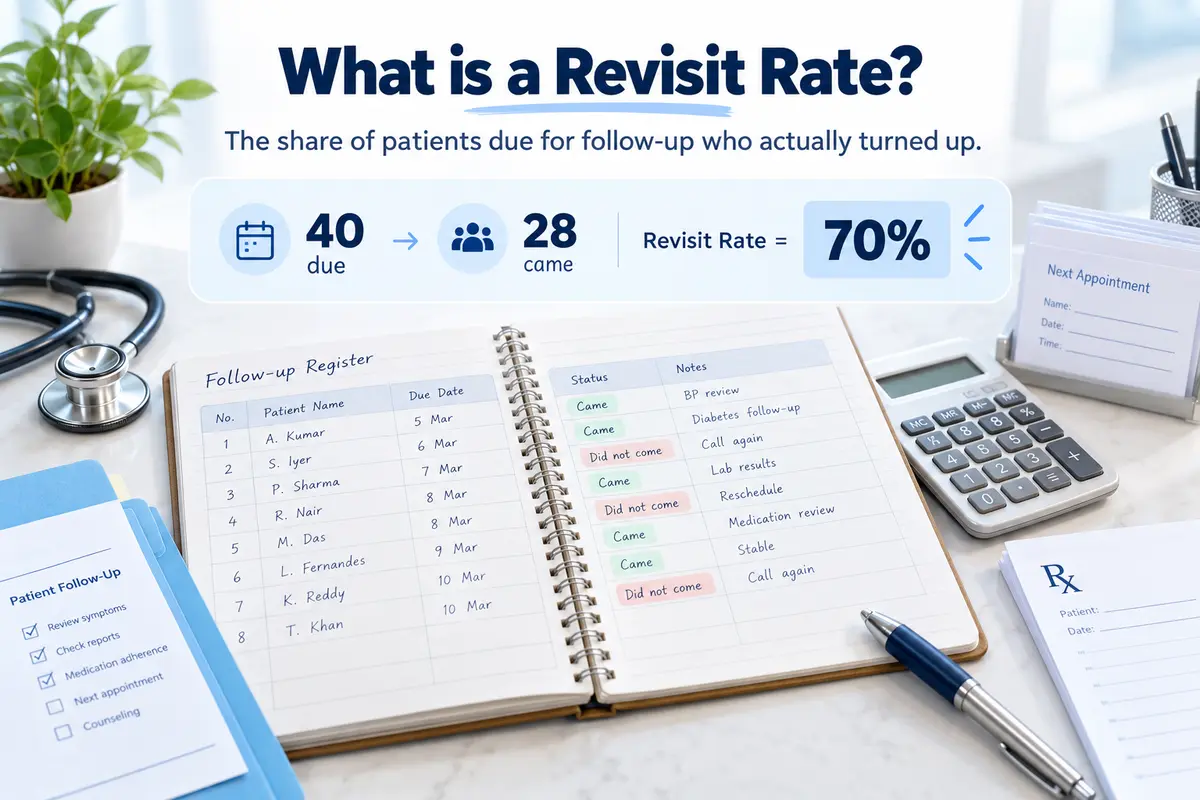
A Revisit Rate is the share of patients who were due for a follow-up in a period and actually turned up. Forty patients had a follow-up date last week. Twenty-eight came. That is your Revisit Rate for the week: 28 out of 40.
We coined the term at Accucia while building the system that now runs a three-branch homeopathy practice in Pune, because no existing word described the thing the owner cared about. "Patient retention" is a yearly idea borrowed from hospitals and gyms. "No-show rate" counts appointments, not courses. A homeopathy clinic lives on something narrower and more urgent: did the patient on a six-month course come back for visit four?
The full definition, with how we track it by branch, doctor and scheme, is in the glossary entry on Revisit Rate. This article is about counting it when all you have is the register.
Why does a homeopathy clinic grow on revisits and not first visits?

A first visit is a conversation. The course is the business. A chronic case, say childhood asthma or alopecia, is written up as a plan of several months with a follow-up every two to four weeks. The fee is spread across those visits, or taken as a scheme up front with a renewal at the end.
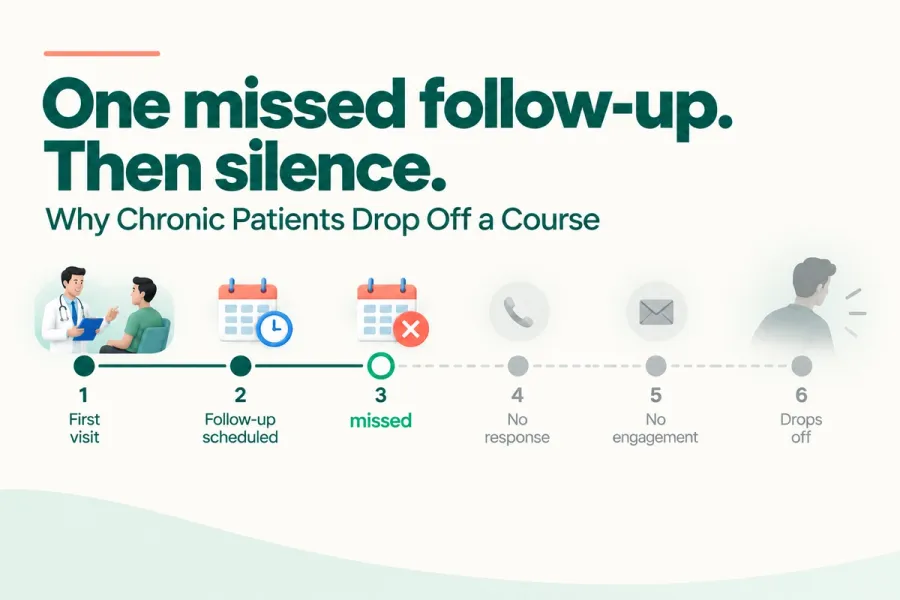
Look at what one missed revisit does to that plan. The patient skips visit four. Nobody at reception notices, because the register only shows who came, not who was supposed to. Three weeks pass. The patient's mother decides the medicine "stopped working" and tries the clinic a relative recommended. Your clinic did not lose one consultation. It lost the rest of the course, the renewal and the referral that would have followed.
Now put that beside a new enquiry from Facebook. Reception has to call, answer questions, book, remind, and hope the patient turns up for a first visit that may or may not become a course. The revisit was already won. It only had to be kept. A clinic grows on its follow-ups, not its first visits.
How do you count it from a register?
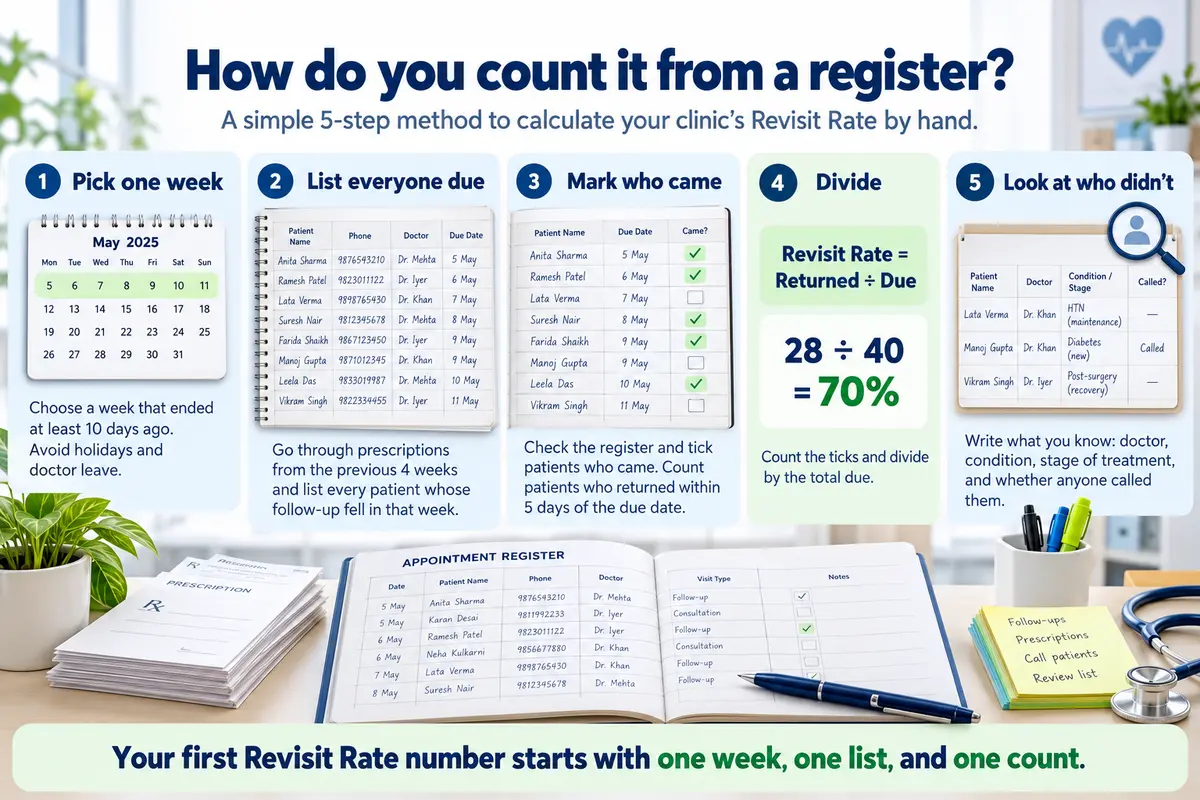
You need the appointment register, the case files or prescription pad copies for that week, and twenty minutes after the last patient has gone. Do it once by hand. Do not build a spreadsheet yet.
Step 1: pick one week
Choose a week that ended at least ten days ago, so late arrivals have had their chance. A full week smooths out the Tuesday that was slow and the Saturday that was packed. Avoid a week with a public holiday or a doctor on leave.
Step 2: list everyone due
This is the step the register cannot do for you, which is the whole point. Go through the prescriptions written in the four weeks before your chosen week. Every prescription has a follow-up date on it, or a "review after 15 days" line. Write down each patient whose follow-up date fell inside your week. Name, phone number, doctor, the date they were due.
At a two-doctor branch this list is usually 30 to 60 names. Write it in a fresh notebook page, one line per patient, with two empty columns on the right.
Step 3: mark who came
Now open the appointment register for that week and tick each name on your list who turns up in it. Also tick anyone who came within five days after their due date, because a patient who was due Monday and came Friday has not dropped off. Leave the rest blank.
Step 4: divide
Count the ticks. Count the names. The patient retention rate formula is the first number over the second. If 40 were due and 28 came, your Revisit Rate for that week is 28 out of 40. Write it at the top of the page with the week's dates. That is the clinic's first measured number.
Step 5: look at the ones who did not
The blank lines are the article. Twelve names with no tick. Before you close the notebook, write one word next to each: which doctor, which condition, how many visits into the course, and whether anyone called them. You will not have all of this. Write what you have.
<aside>
📍
See this running with your own branch names. Book a Patient Journey Review.
</aside>
What does 40 due and 28 came actually mean?
Twelve patients did not come back in one week at one branch. Multiply that by the weeks in a month and the branches you run, and you have a number that is bigger than the number of new patients Facebook sent you in the same month. Most owners have never seen that comparison, because the new-patient number is on a Meta ads report and the lost-patient number is nowhere.
Twelve is also not twelve consultations. Each name is somewhere in a course. A patient two visits into a four-month plan represents the rest of that plan. If a scheme was sold, the renewal that would have followed is now unlikely. The twenty-eight who came are the clinic's income this month. The twelve are the income it will not have next month.
Resist the urge to decide whether 28 out of 40 is good or bad. Nobody publishes an honest benchmark for homeopathy clinics in India, and the owners who tell you their number at conferences are guessing. Your number is a baseline. Count it again in a month and see which way it moved.
What do the twelve who did not come have in common?
Lay the twelve blank lines side by side and patterns appear within a few minutes. Here is what owners usually find the first time.
Most of them are between visit two and visit four. The first follow-up is close to the first visit and the patient is still motivated. Drop-off starts when the early improvement has either arrived or has not, and nobody from the clinic has spoken to them in between.
Several of them share a doctor, and it is not a judgement on the doctor. One doctor writes "review in 15 days" and the other writes a date. The dated prescriptions get rebooked at the counter. The others are left to the patient's memory. Nobody called any of them. Reception will say, reasonably, that they did not know who was due. The register shows arrivals. The due list only exists because you built it tonight.
Two or three of them are patients of another branch. They came to Branch A for their first visit and were supposed to continue at Branch B near their home, and the file never followed them, so Branch B had no reason to expect them.
Each of these is a leak with a fix, and the fix is almost never "remind the doctors to be more careful". The fix is a list that exists every morning without anyone building it.
What changes when the system counts it for you?
RevisitPlus does the twenty-minute exercise every day, for every branch, without a notebook. When a doctor writes a prescription on the Doctor Dashboard, the follow-up date goes on the patient's record. The next morning that patient is on the due list for reception. If the day ends and the patient has not come, the missed visit appears the same day on the doctor's screen and on reception's screen. Nobody has to go looking for it.
Reception calls from that list. The call is logged against the patient, so when the owner asks "did anyone call Mrs. Deshpande", the answer is on the file, with the time and the outcome. If the patient rebooks, the due date moves. If the patient went to another branch, the record is the same record, so Branch B sees the course exactly where Branch A left it.
The owner sees the Revisit Rate by branch, by doctor and by treatment scheme on the Owner Dashboard, on the web and on the Android app. The number stops being a once-a-month notebook exercise and becomes something you glance at on the phone on the way in. The twelve blank lines become twelve names with a call status beside each.
We do not publish outcome percentages until they are measured from the system and signed off by the clinic, so this article will not tell you how far the number moves. The way to find out is to count your own tonight, and count it again after the list exists every morning.
Frequently asked questions
What is a good revisit rate for a homeopathy clinic?
There is no published benchmark for homeopathy clinics in India that we would trust, and we do not publish one ourselves. Treat your first count as a baseline. Count it again next month. A clinic that moves from 28 out of 40 to 33 out of 40 has kept five courses it would have lost, and that is the comparison worth making.
How often should I count my clinic's revisit rate?
By hand, once a month per branch is realistic and enough to see a trend. Weekly counts by hand tend to stop after three weeks because the due list takes the longest to build. Once a system builds the due list for you, the number is available every day and the monthly count becomes a glance at a report.
Is revisit rate the same as patient retention rate?
They are cousins. Patient retention rate usually asks how many patients from a year ago are still patients today. Revisit Rate asks a shorter, sharper question: of the patients due back this week, how many came. For a clinic selling multi-month courses, the weekly question tells you about the leak while there is still time to call the patient.
How do I track follow-up visits without software?
Keep a due list, separate from the appointment register. Each time a doctor writes a follow-up date, reception copies the name and date into a dated page of a notebook. Every morning, reception reads that day's page and calls anyone who has not booked. It works at one branch with one disciplined receptionist. It breaks at two branches.
Why do homeopathy patients stop coming for follow-ups?
Rarely because of the medicine. Usually because the early improvement arrived and they felt done, or it had not arrived and they lost faith, and in both cases nobody from the clinic spoke to them between visits. Distance, a change of branch, and a follow-up date the patient never wrote down account for most of the rest.
Can clinic software calculate revisit rate automatically?
Yes, if the software records the follow-up date when the doctor writes the prescription and then checks arrivals against it. RevisitPlus does this and shows missed visits the same day to the doctor and to reception, with the Revisit Rate by branch, doctor and scheme on the Owner Dashboard. Software that only stores appointments cannot, because it never knew who was due.
What is the difference between a missed appointment and a dropped course?
A missed appointment is one date the patient did not keep. A dropped course is a patient who has stopped coming and will not return without a conversation. The first becomes the second in about three weeks if nobody calls. The point of counting revisits weekly is to catch patients while they are still in the first category.
Bottom line
Your clinic already has the data to count its Revisit Rate. It is spread across the prescription copies and the appointment register, and nobody has put the two side by side. Tonight, after the last patient, pick a week from last month, list everyone due, tick who came, and write the twelve names who did not. That list is the most useful page in the clinic.
this is my blog give me tagline