Why Chronic Patients Drop Off a Course

Sumeet Katariya
Founder, Accucia Softwares and RevisitPlus
Chronic patients drop off a homeopathy course not by deciding to quit but by missing one follow-up that nobody noticed. The medicine runs out, the symptom eases or does not, and by month three the course is over without anyone calling it over. The clinic's window is the first week after the missed visit: see it the same day, call the same day, and reschedule before the second dose is missed. By Sumeet Katariya · Founder, Accucia Softwares and RevisitPlus
Nobody decides to quit a course
Ask a chronic patient who stopped coming why she stopped, and she will rarely say she gave up on the treatment. She will say the second month got busy, or the medicine finished and she meant to come, or the rash settled and she thought she would wait and see. There was no moment of quitting. There was a Tuesday she did not come, and then a silence that nobody broke.
That is what patient drop off looks like from the counter. The chair at 11 am is empty, the next patient is called early, and the empty slot is forgotten by lunch. Nobody wrote her name anywhere because the diary only records who came.
A course for alopecia, childhood asthma or anxiety runs for months and depends on the follow-up more than on any single visit. The follow-up is where the doctor sees the response and adjusts. A patient who misses it is not being difficult. She has just fallen out of a rhythm that only the clinic can hold.
What actually happens in the week after a missed follow-up
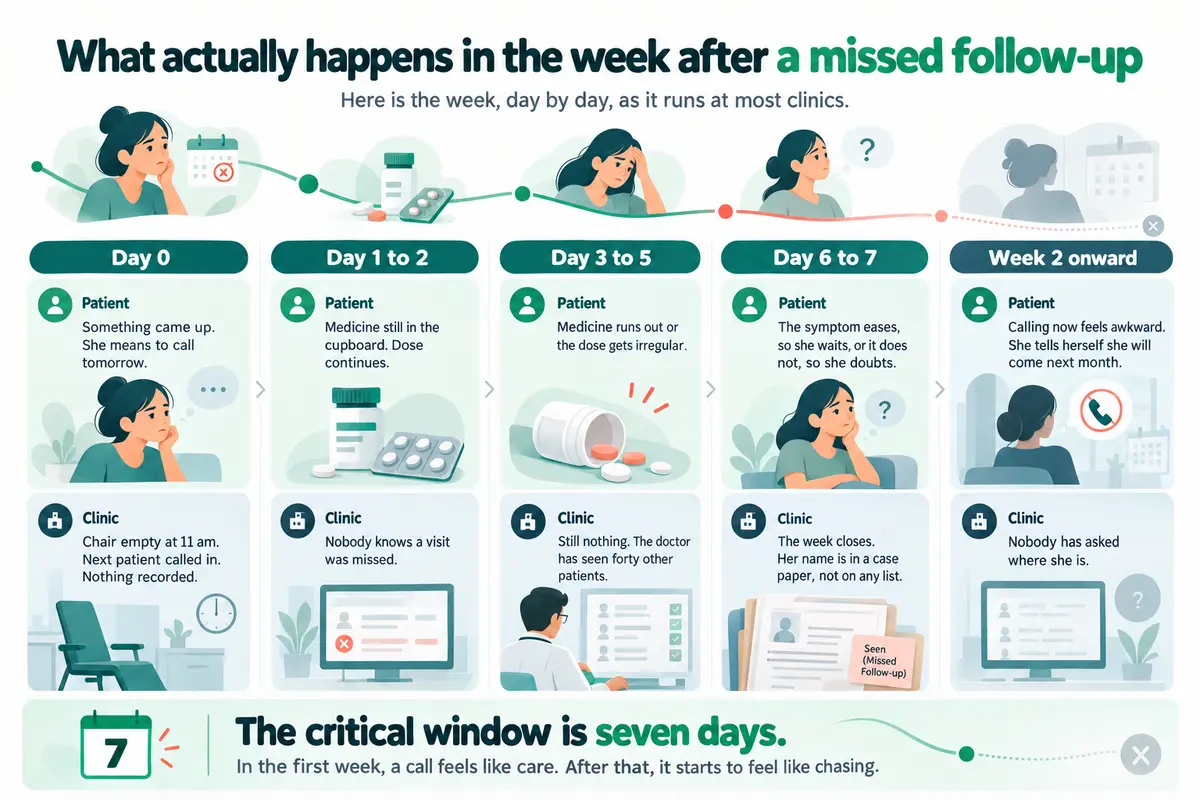
Here is the week, day by day, as it runs at most clinics.
Day 0: The missed visit
Patient: Something came up. She means to call tomorrow.
Clinic: The chair is empty at 11 am. The next patient is called in. Nothing is recorded.
Day 1 to 2
Patient: Medicine is still in the cupboard, and the dose continues.
Clinic: Nobody knows a visit was missed.
Day 3 to 5
Patient: Medicine runs out or the dose gets irregular.
Clinic: Still nothing. The doctor has seen forty other patients.
Day 6 to 7
Patient: The symptom eases, so she waits, or it does not, so she doubts.
Clinic: The week closes. Her name is in a case paper, not on any list.
Week 2 onward
Patient: Calling now feels awkward. She tells herself she will come next month.
Clinic: Nobody has asked where she is.
Notice that in the first five days the patient is still a patient. The medicine is being taken, the symptom is being watched, and a call from the clinic is simply the clinic doing its job. After day seven the situation changes on both sides. She feels she has lapsed, and the clinic, if it notices at all, feels it is chasing.
That is why the window is seven days. Not because of anything clinical, but because of how people behave when nobody calls.
Why month three is too late
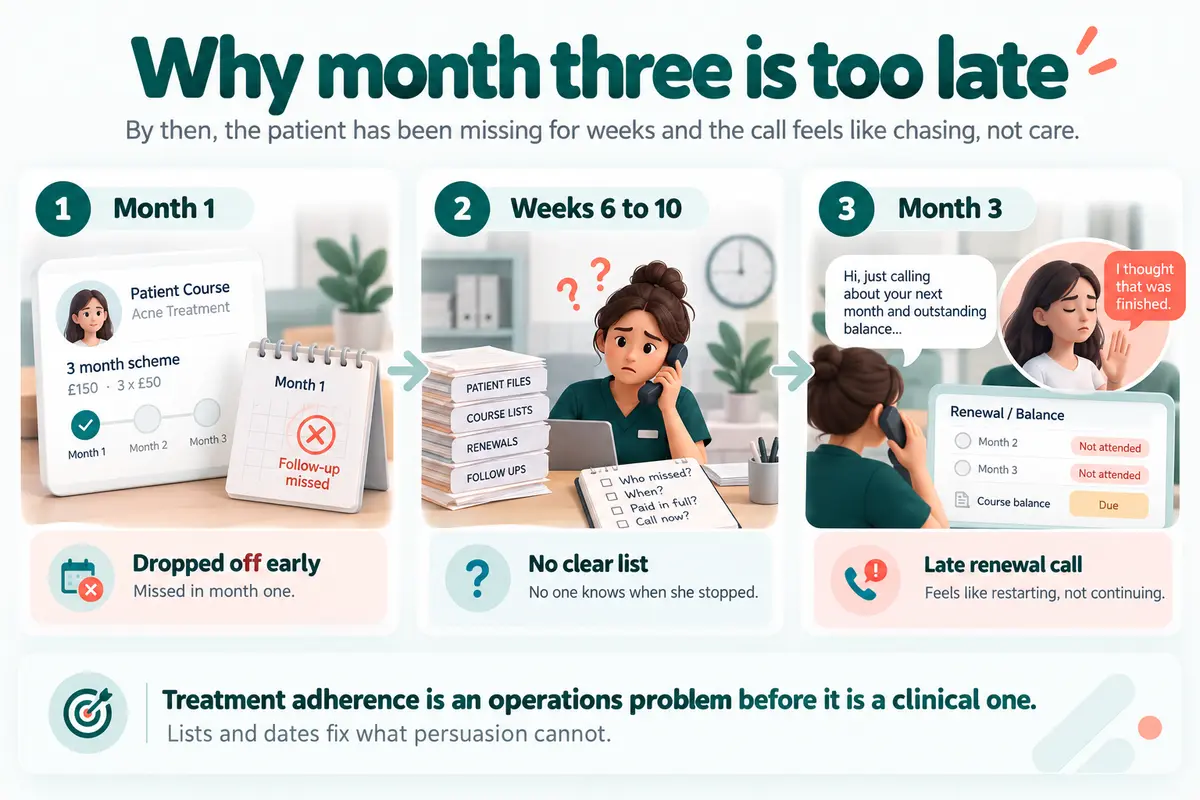
Month three is when the course was supposed to end. It is when the doctor looks at the scheme list, or the owner looks at the renewals, and asks who is still coming. The names that are missing have been missing for six to ten weeks by then.
A call at month three is a different call. It is about a balance, or a renewal, or a form. It arrives after the patient has already decided, in her own mind, that the course is over. Reception is now asking her to restart something rather than continue it.
The owner usually meets this at the nine o'clock phone round, when the renewals for the month look thin and nobody at the desk can say which patients went quiet or when. The answer is in the case papers, one file at a time, which is why it is never found.
The cost sits in the clinic's numbers too. A patient who drops off in month one has paid for one month and taken up a scheme slot. A patient who completes the course is the one who renews, refers and comes back next year with her son. Treatment adherence in homeopathy is an operations problem before it is a clinical one, and operations problems are fixed with lists and dates, not with persuasion.
The three moments a clinic can act
The useful thing about a chronic course is that its calendar is known in advance. The doctor set the follow-up date. The medicine was dispensed for a known number of days. The scheme has an end date. Three moments are already in the clinic's hands, if anyone is looking at them.
The same day
The visit was due today and did not happen. By closing time, her name should be on a list that someone owns. At a paper clinic that means reception compares the appointment diary with the register before the drawer is counted at 8:30 pm, writes the missing names on a page, and the page is on the counter at 9 am. In RevisitPlus the list appears on its own, on the doctor's screen and on reception's, the same day.
The call happens the next morning, before the first patient, and it offers a new date rather than a reminder for the visit that passed.
The medicine-finished message
The doctor knows how many days of medicine went home. A message on the day it runs out, from the clinic's own WhatsApp number, saying the medicine finishes today and the next visit is on such a date, lands at exactly the moment the patient would otherwise drift. It is not a sales message. It is the clinic keeping count so she does not have to.
If the follow-up is already booked, the message confirms it. If it is not, the message asks her to reply with a day. Either way, the clinic has spoken before the silence started.
The course end date
Every scheme should carry an end date from the day it is assigned. Two weeks before that date, the patient hears from the clinic about the last visit of the course and what happens after it. The doctor sees the same date on the file and can plan the closing consultation.
Renewal is then a conversation at the final visit, with the doctor, with the history in front of both of them. It is not a call from reception at month three to someone who stopped coming in month one.
What a same-day missed-visit list changes for the doctor
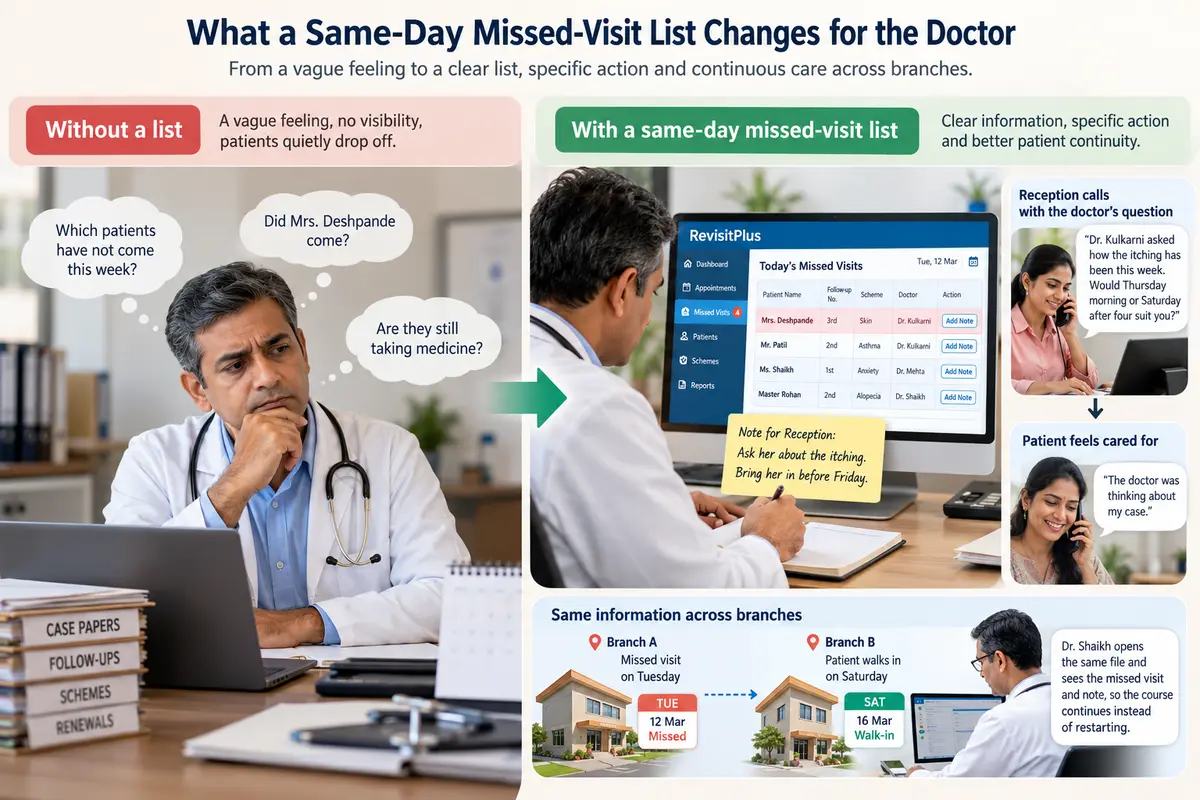
Most clinics think of follow-up tracking as reception's job. The bigger change is on the doctor's side.
Without a list, the doctor carries a vague unease about patients who seem to have vanished, and no way to act on it between consultations. With a same-day list on the Doctor Dashboard, Dr. Kulkarni finishes the evening by looking at four names, not at a feeling. Mrs. Deshpande, due today for her third follow-up, did not come. The doctor can add a line for reception: ask her about the itching, bring her in before Friday.
That one line changes the call. When reception calls with a specific question from the doctor, the patient hears that the doctor was thinking about her case. When reception calls with "you missed your appointment", the patient hears a desk.
It also closes the branch gap. If she missed Branch A on Tuesday and walks into Branch B on Saturday, Dr. Shaikh opens the same file and sees the missed visit and the note, so the course continues instead of restarting.
Patient follow up software earns its place here, not in the reminder it sends but in the list it builds without anyone remembering to build it. The list is the product. The messages are the delivery.
What to say when you call
Keep it short, keep it about her, and have the file open before dialling.
- Say who you are and which doctor you are calling for. "This is Branch A reception, calling for Dr. Kulkarni."
- Say what you noticed, without blame. "Your follow-up was due on Tuesday and we did not see you."
- Ask the doctor's question if there is one. "Dr. Kulkarni asked how the itching has been this week."
- Offer two dates, not an open question. "Would Thursday morning or Saturday after four suit you?"
- Confirm the medicine. "Do you still have enough medicine until then?"
- Log the outcome on the file before the next call. Rescheduled, will call back, could not reach, or needs the doctor.
Two rules on top. Call within one working day of the missed visit, and let the same person own the list until every name has an outcome. A name that has no outcome after three attempts goes back to the doctor, not into silence.
Bottom line
Chronic patients do not leave a course. They miss one follow-up that nobody noticed, and the clinic finds out at month three. The fix is a list that appears the same day, a call the next morning with the doctor's question in it, and a message on the day the medicine runs out. Tonight, compare this week's appointment diary with the register and write down every name that was due and did not come. Call them tomorrow before 10 am.
Frequently asked questions
Why do patients stop coming to homeopathy clinics?
Mostly because one follow-up was missed and nobody from the clinic noticed or called. The medicine runs out, the symptom eases or does not, and the patient feels she has lapsed. Clinics rarely lose a chronic patient to a decision. They lose her to a silence that starts on the day of the missed visit and is not broken within the week.
How do I get patients to complete their treatment course?
Hold the calendar for them. Set the follow-up date at every visit, see the same day when one is missed, call the next morning with the doctor's question, and message on the day the medicine runs out. Give every scheme an end date and plan the final visit with the doctor. Completion follows from the clinic keeping count, not from the patient's willpower.
How soon should a clinic follow up after a missed appointment?
Within one working day. In the first week the patient is still taking the medicine and a call from the clinic feels like care. After seven days she feels she has lapsed and the call feels like chasing, on both sides. The missed visit should be on a list the same day and the call made before the first patient the next morning.
What should reception say when calling a patient who missed a visit?
Say who you are and which doctor you are calling for, say the visit was due and you did not see her, ask the doctor's specific question if there is one, offer two concrete dates, and check she has medicine until then. Then log the outcome on the file. The call is about her case, not about the appointment she missed.
Do WhatsApp reminders improve follow-up attendance?
We do not publish percentages until they are measured from the system and signed off by a clinic. What we can say is that a reminder sent from the clinic's own verified WhatsApp number, before the visit and again on the day the medicine runs out, reaches the patient at the moment she would otherwise drift, and the same-day missed list catches whoever still does not come.
How does a doctor know which patients missed follow-ups?
With a list built from the follow-up dates the doctor set, showing the same day who was due and did not come. On the Doctor Dashboard in RevisitPlus that list appears on its own, at every branch, and the doctor can add a note for reception to use on the call. Without a list, the doctor finds out at month three.
What is treatment adherence in homeopathy?
Treatment adherence is the degree to which a patient follows the course as prescribed: takes the medicine as directed, attends the follow-ups and completes the scheme to its end date. For a clinic it is measured by Revisit Rate, the share of patients who come back for their next scheduled follow-up, tracked by doctor, branch and scheme.