Clinic Day-End Cash Reconciliation Guide

Sumeet Katariya
Founder, Accucia Softwares and RevisitPlus
Clinic day-end cash fails to match for four ordinary reasons: split payments across cash and UPI, discounts given at the counter and never recorded, scheme instalments taken at one branch for a scheme written up at another, and handwritten receipts with unreadable copies. The fix is not stricter counting. It is recording every payment against the visit it belongs to, at the moment it is taken, so day-end becomes a report rather than a search. By Sumeet Katariya · Founder, Accucia Softwares and RevisitPlus
Why nobody is stealing and the drawer still does not match
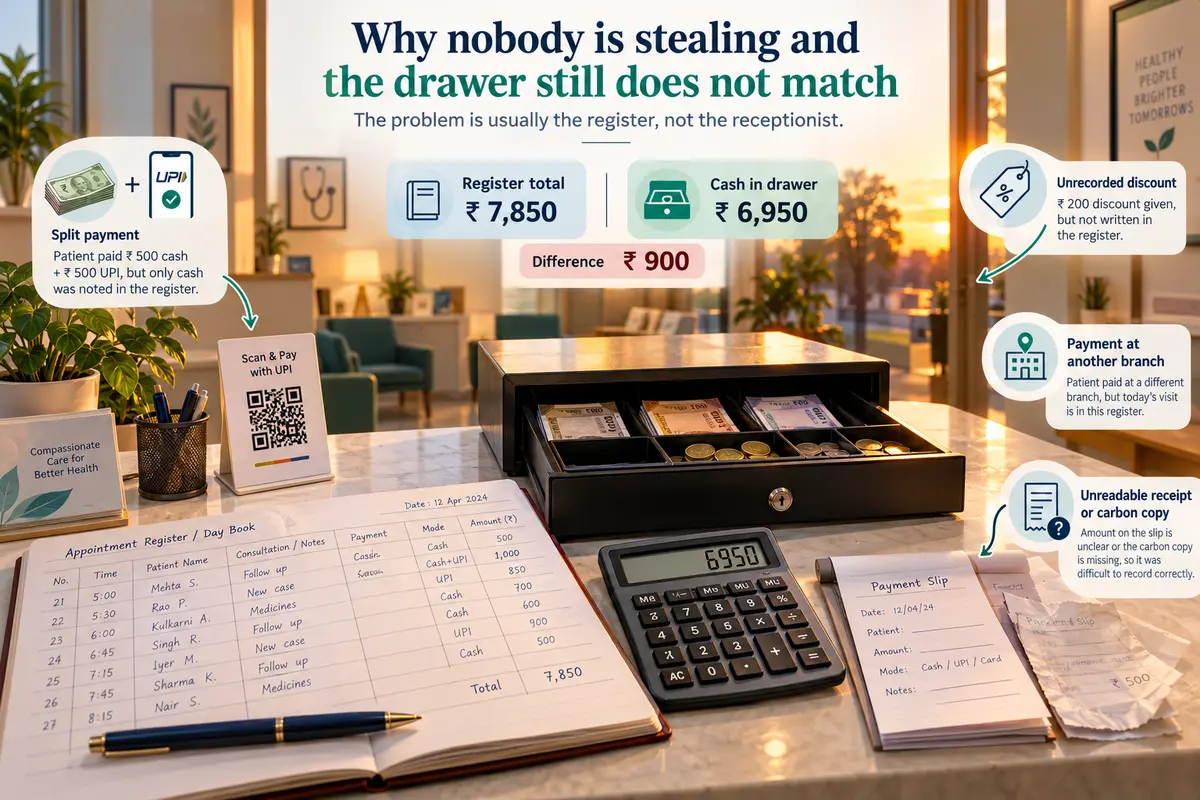
It is 8:30 pm. The last patient left at 8:10. Reception has counted the drawer once, compared it with the register, and the two numbers are not the same. So reception counts again, slower, and gets the same answer. The owner, at home, receives a photo of the register page with the day's total circled and a message that says "short, will check tomorrow".
Most owners, the first time this happens, think about the receptionist. The second and third time, they think about a second receptionist to watch the first. Neither is the answer, and both poison the room. In eight years of building systems for clinics, the mismatch has almost never been theft. It has been the register.
An appointment register records that Mrs. Deshpande came at 11:20 and saw Dr. Kulkarni. The payment is written somewhere else: a receipt book, a column at the edge of the same page, a UPI notification on the clinic phone. The visit and the money are two records, kept by two methods, reconciled by a tired person at 8:30 pm. Four ordinary things happen between the two, and each one is enough to make the drawer wrong.
Reason 1: half cash, half UPI
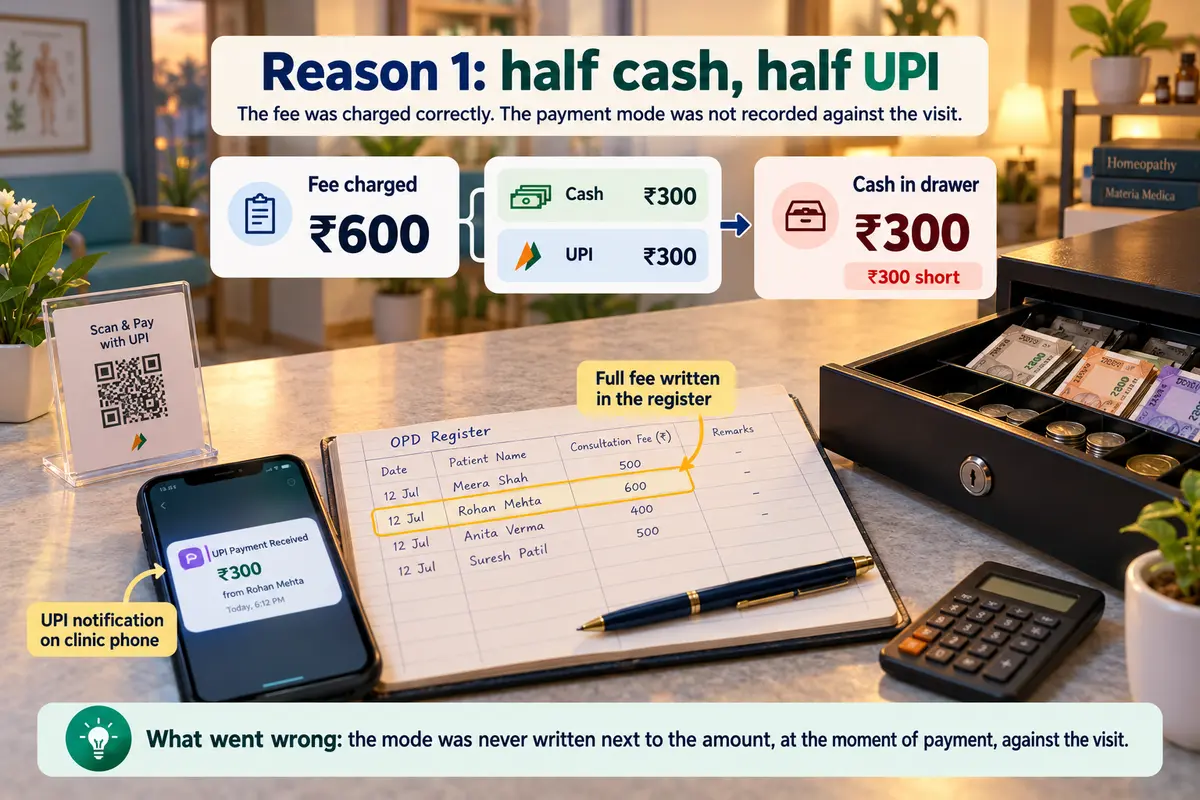
A patient's fee is more than the cash in her purse, so she pays part by UPI and the rest in notes. Reception writes the full fee in the register, because the fee is what was charged. The drawer now holds less cash than the register says, and the UPI half is a notification on a phone that three people use.
At day end, the cash total is short by exactly the UPI half, and the UPI total on the phone is higher than anyone expected. If reception is lucky, the two differences match and the day closes. If two patients split in the same afternoon, or one paid the whole fee by UPI and said so to the doctor rather than to reception, the arithmetic takes twenty minutes and ends in "roughly".
What went wrong is not the UPI payment itself but that the mode was never written next to the amount, at the moment of payment, against the visit.
Reason 2: the discount nobody wrote down
A long-standing patient asks for a concession. The doctor nods through the door. Reception takes the reduced amount, writes the full fee in the register because that is the printed fee, and intends to note the difference later. Later does not come, because the next patient is already at the counter.
Multiply this by a family discount, a staff member's relative, a free follow-up the doctor promised, and a scheme patient whose consultation is covered by the scheme but gets written up as a visit anyway. By 8:30 pm the register says one number, the drawer says another, and the difference is a set of small, perfectly reasonable kindnesses that nobody recorded.
The owner, reading the register at month end, sees fees that were never collected and cannot tell a discount from a loss. That is a reporting problem as much as a counting one.
Reason 3: paid at Branch B, recorded at Branch A
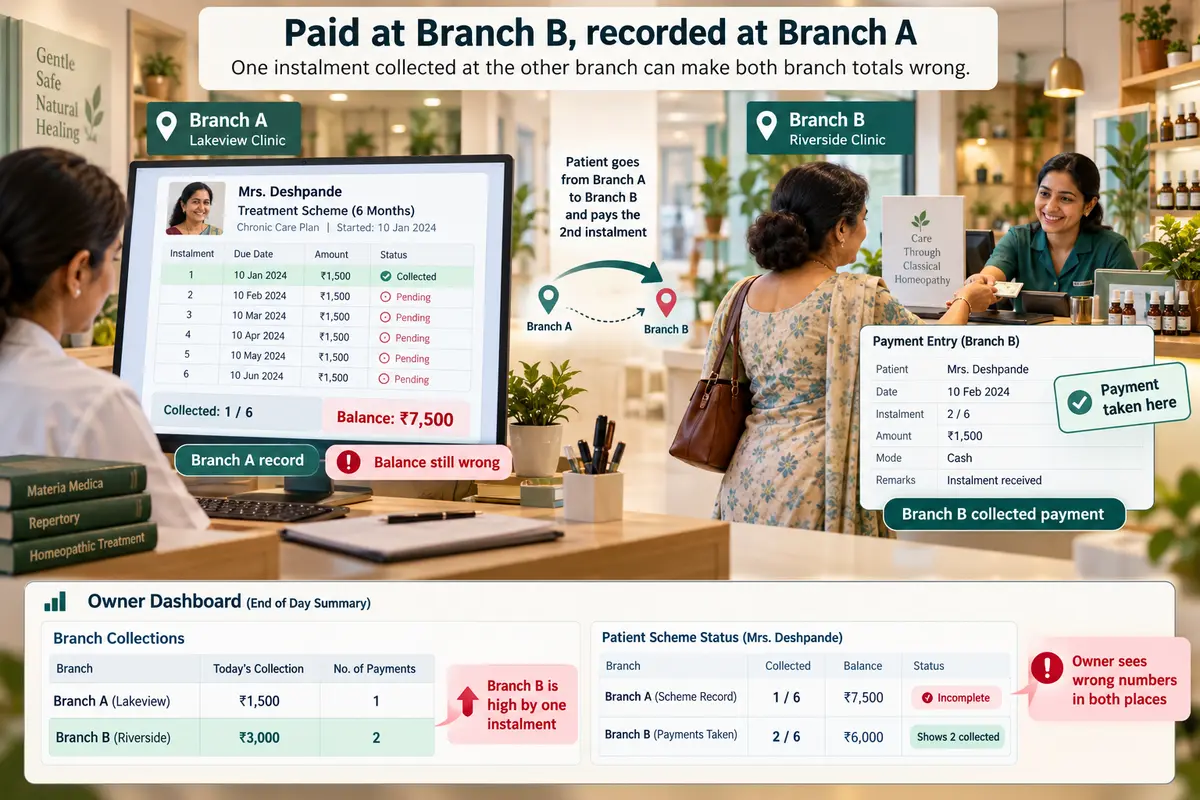
A multi-branch clinic has this reason on top of the first two. Mrs. Deshpande's six-month scheme was written up at Branch A in June, with the total and the instalment plan in Branch A's file. In August she is near Branch B, walks in, and pays her second instalment there.
Branch B takes the money and writes it in Branch B's register, because that is where it was received. Branch A's file still shows one instalment collected. Branch B's day-end is high by one instalment with no scheme to attach it to. Branch A's scheme balance is wrong for as long as it takes for someone to remember to phone. The owner's collections by branch are wrong in both directions at once.
Then in October, the scheme ends, and nobody at either branch knows whether the third instalment was ever paid. The renewal conversation does not happen, because reception cannot see a balance to talk about, and the patient leaves with a question nobody asked.
Reason 4: the unreadable carbon copy
The receipt book is the clinic's only proof of what was paid. It is also handwritten, in a hurry, through a carbon sheet that has been used for forty receipts. The patient's copy is clear. The clinic's copy, the one that will be reconciled, has a figure that could be a three or an eight, and a date that is mostly a smudge.
Reception, at 8:30 pm, reads the smudge as the number that makes the drawer match. Nobody is doing anything dishonest. The receipt book is simply not a record that can be checked against anything, and a clinic receipt that cannot be read is a receipt that was never issued.
A five-minute day-end: what it looks like
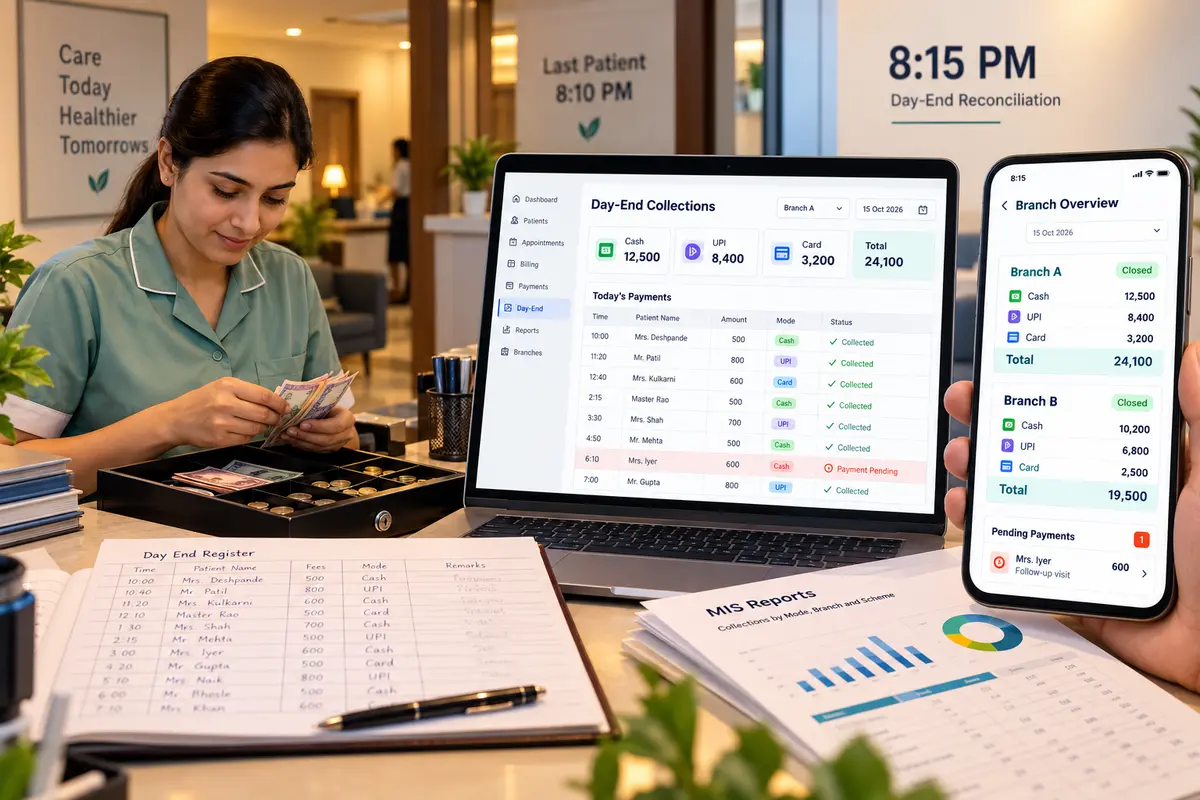
It is 8:15 pm at Branch A. The last patient has gone. Reception opens the day-end view and sees today's collections by mode: so many payments in cash, so many by UPI, so many by card, with the totals for each. The cash figure is the number to count against the drawer. There is no second number to reconcile it with, because the cash figure was built from the visits as they happened.
Reception counts the drawer once. If it matches, the day is closed and the owner's dashboard already shows it, by branch and by mode, on the web and on the Android app. If it does not match, the list of cash payments for the day is on the screen with the patient name and time against each, and the difference is found by reading, not by counting again. A visit with no payment against it is visible as exactly that, and gets a reason: scheme-covered, discount, or a payment still to take.
The owner, at home, does not get a photo of a register. The owner opens the dashboard and sees Branch A closed, Branch B closed, collections by mode for both, and the one visit at Branch B with a payment still to take. The MIS Reports carry the same payments by mode, branch and scheme to the accountant, exported to Excel, without anyone retyping a register. Online payments through Razorpay land against the visit the same way as cash, and the full list of what is connected is on the integrations page.
We do not publish time savings as figures, because we have not measured them from the system and had the clinic sign them off. What we can say is that the second count stops, and that the practice RevisitPlus was built inside no longer sends anyone a photo of a register at 8:30 pm.
Frequently asked questions
How do clinics reconcile cash at the end of the day?
Well-run ones never reconcile in the old sense. Each payment is recorded against the visit at the moment it is taken, with its mode, so the day-end view already shows cash, UPI and card totals built from the visits. Reception counts the drawer once against the cash figure. If there is a difference, the list of cash payments with names and times is on the screen to read through.
Why does my clinic's cash not match the register?
Because the register records the visit and the payment separately, and four ordinary things happen in between: a fee split between cash and UPI, a discount taken but not noted, a scheme instalment collected at the other branch, and a carbon copy nobody can read. None of these is theft. All of them disappear when the payment is recorded against the visit, by mode, as it happens.
How do I record UPI payments at a clinic?
Record the mode next to the amount, against the visit, at the counter, rather than relying on the notification on the clinic phone. A split payment is two lines, one cash and one UPI, on the same visit. Day-end then shows the UPI total built from visits, which can be checked against the UPI app once, instead of matched by memory at 8:30 pm.
Can clinic software track partial payments for treatment packages?
Yes, if the scheme is a record of its own and not just a note on the file. RevisitPlus sets up each scheme once with its name, duration and amount, assigns it during the patient log, and shows the total, the amount collected and the amount remaining on every visit. An instalment taken at any branch updates the same balance, so renewal conversations happen at the right visit.
How do multi-branch clinics track payments?
By keeping one patient record and one scheme record across branches, so a payment taken at Branch B goes against the same visit or scheme that Branch A can see. Day-end totals are then shown by branch and by mode, and the owner sees all branches on one dashboard without phoning either. Separate registers per branch cannot do this, and the scheme balance is where it shows first.
What is the best way to issue receipts at a clinic?
Generate the receipt from the payment record rather than writing it beside the payment, so the receipt and the day-end total come from the same entry. Send it to the patient on WhatsApp from the clinic's own verified number, which gives the patient a copy they can find and the clinic a copy that can be read. A carbon copy that cannot be read is a receipt that was never issued.
Does clinic software integrate with Razorpay?
RevisitPlus does. Razorpay is live for online payments, and a payment made through it lands against the patient's visit the same way as cash, UPI or card at the counter, so it appears in the day-end totals by mode and on the owner's dashboard. The other live integrations are the WhatsApp Business API, Meta lead forms and the website enquiry form. Tally is not integrated yet, so ask us if your accountant needs it.
Bottom line
The drawer does not match because the clinic keeps the visit and the payment in two places, not because of anyone at the counter. Tonight, before the count, write the mode next to every amount in the register and circle every discount and every scheme instalment. Tomorrow's day-end will tell you which of the four reasons is yours, and that is the one to fix first. give me tagline