Is Your Clinic Ready for a Second Branch?

Sumeet Katariya
Founder, Accucia Softwares and RevisitPlus
A homeopathy clinic is ready for a second branch when its first branch runs without the owner in the room: enquiries are owned, follow-ups are noticed the same day, every patient has one record, day-end matches, and the owner can see the week without phoning. It is not ready when the systems live in one receptionist's memory, because a second branch doubles the leaks before it doubles the patients. By Sumeet Katariya · Founder, Accucia Softwares and RevisitPlus
Why the second branch is harder than the first
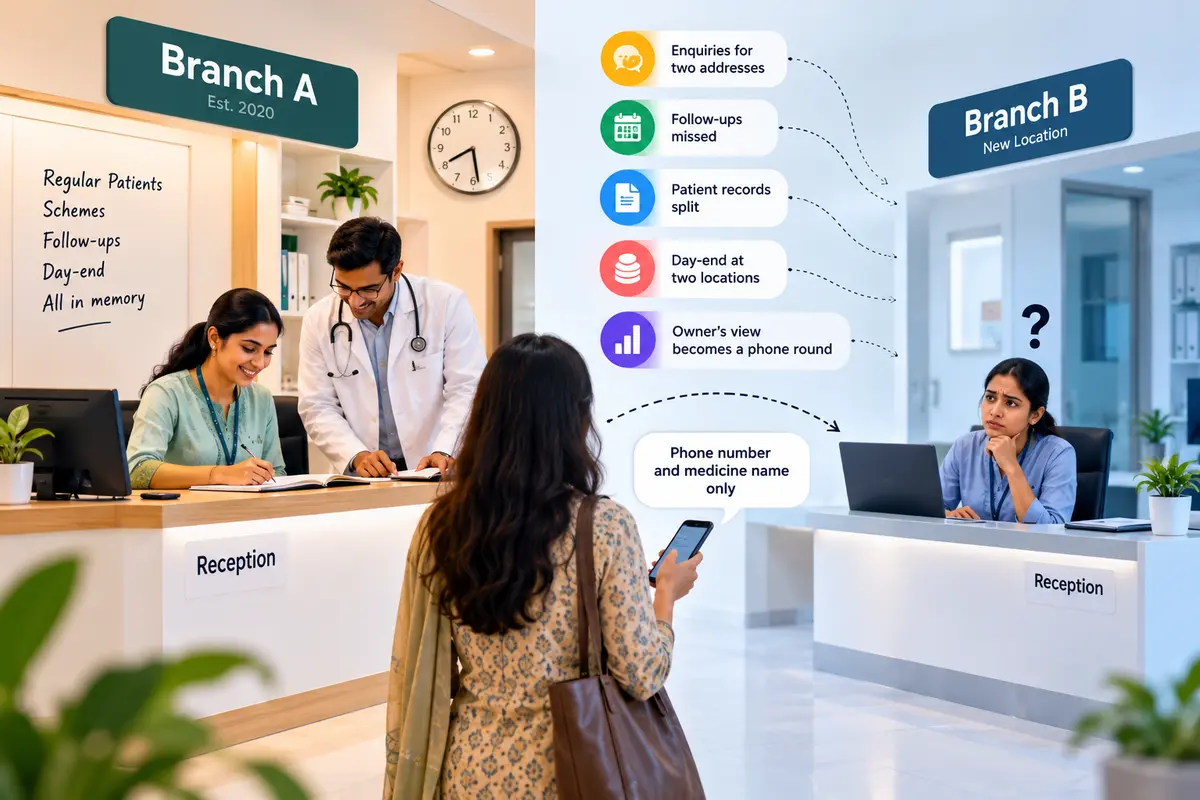
The first branch grew on the owner's memory. The doctor knew which patient was on which scheme, reception knew who had not come back, and the two of them talked at the counter at 8:30 pm while the drawer was counted. That is a working system. It just has one copy.
A second clinic branch asks for a second copy of that memory, in a different building, with a receptionist who was hired last month. The doctor cannot be at both counters at 8:30 pm. The old patient who moves house and walks into Branch B carries nothing except a phone number and the name of her medicine.
So the five places a clinic loses patients open up at the same time. Enquiries now land for two addresses. Follow-ups are missed at a branch the owner is not standing in. Patient records split in two. Day-end happens at two drawers in two buildings. The owner's view of the week turns into a nine o'clock phone round.
None of this means the second branch is a bad idea. It means the question is not "can we afford the branch" but "does Branch A run without me in the room". The reception desk answers that question better than the balance sheet, which is why every sign below is judged from there.
Nine signs you are ready
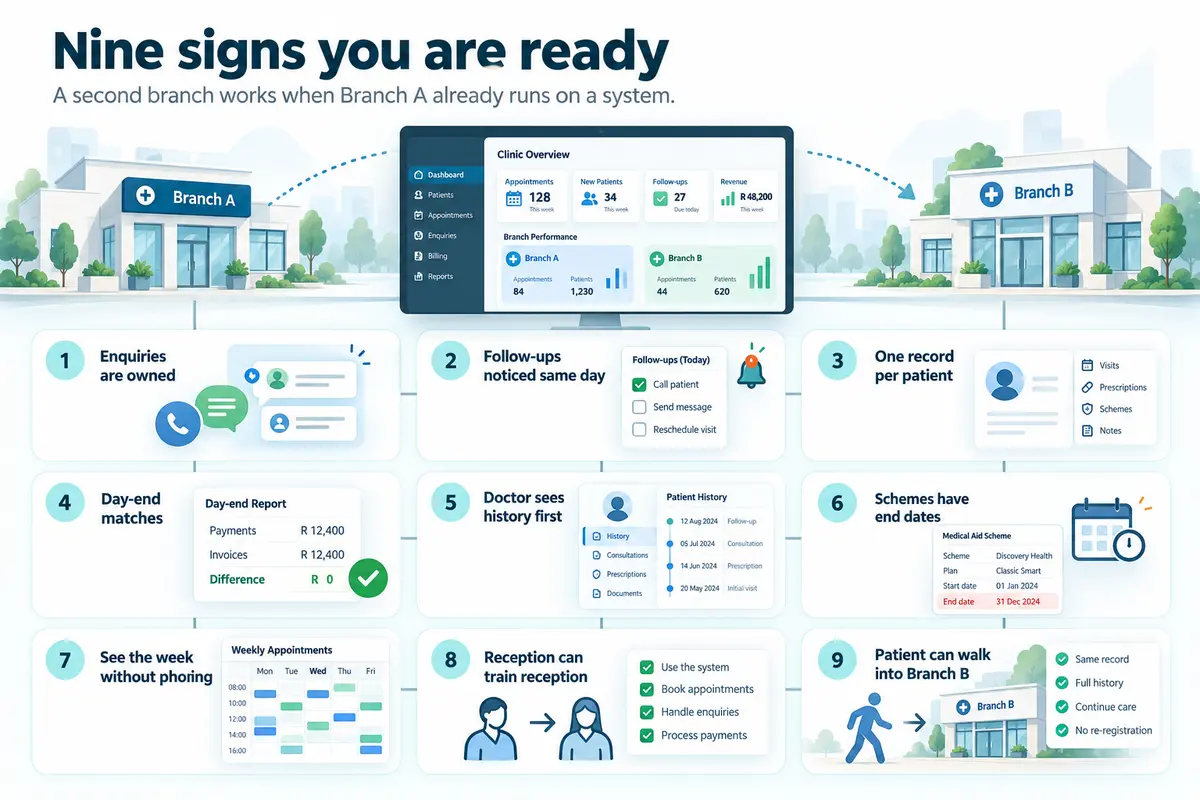
Read each one with your own reception in mind. "Yes" should mean "yes, last week, without anyone chasing".
Enquiries are owned
A Facebook enquiry came in on Tuesday. On Thursday, can anyone at the desk say who called her back, what she asked, and whether she booked? If the answer is a name, a time and a status, enquiries are owned. If the answer is "let me check the page", they are not.
The test is not whether you get enquiries. The test is whether one list holds all of them, from the page, the website form, WhatsApp and the phone, and whether one person per shift is responsible for working that list.
Follow-ups are noticed the same day
At 11 am the chair is empty. The patient was due for her third follow-up and did not come. Does anyone know by closing time, or does it surface in month three when the doctor wonders what happened to her?
A clinic that is ready has a missed-visit list that someone looks at every evening, and a rule about what happens to each name on it. The list can be a page in a diary. What matters is that it exists and gets worked.
One record per patient
Pick a chronic patient at random. How many places hold part of her story? A case paper in a cupboard, a WhatsApp thread with the doctor, a payments register, a prescription book. If the answer is more than one, you have more than one record, and Branch B will add another.
Ready looks like this: one file, opened by phone number, holding history, prescriptions, follow-up dates and payments. Whoever opens it sees the same thing.
Day-end matches
At 8:30 pm the drawer is counted. Cash, UPI and card are added up by mode and compared with the visits of the day. Ready means the two numbers agree most evenings and the exceptions have a reason written next to them.
If day-end is a feeling rather than a comparison, the second branch will have a second feeling, and nobody will be able to say which drawer is short.
Doctors see history before the consult
Does the doctor open the file before the patient sits down, or does the patient retell the case from the start? A clinic that is ready has the last prescription, the current scheme and the next due date in front of the doctor at the moment the name is called.
This matters twice as much with two branches. The Branch A patient at Branch B should not need a phone call to Branch A before anyone can prescribe.
Schemes have end dates
Every treatment scheme should carry a start date, an end date, an amount, what has been collected and what remains, visible on every visit. If the end date lives in the doctor's head, renewals get missed, balances get argued, and the second branch inherits the arguments.
You can see the week without phoning
The owner's nine o'clock phone round is the clearest sign of all. If you have to call reception to learn how many new patients came in, how many follow-ups were kept and what was collected by mode, your view of the clinic depends on who answers the phone. With two branches that is two calls every morning, and the second one is usually about the first.
Ready is when the week is on a screen you can open from the car.
Your reception could train a new reception
Ask your receptionist to write down what she does between 9 am and 1 pm. Registering, assigning the doctor, taking payment, logging the enquiry call, updating the missed list. If she can write it as steps, a new person at Branch B can follow the steps. If she says "it depends", the process is her, and she cannot be in two buildings.
A patient could walk into the new branch tomorrow
The final sign is the whole article in one line. Mrs. Deshpande, a Branch A patient since January, walks into Branch B next Tuesday. Reception finds her by phone number, Dr. Shaikh opens her file and sees Dr. Kulkarni's last prescription, and her scheme balance is on the screen. Nobody picks up the phone.
If you can say yes to that scene with your current setup, you are ready for the second branch. If the scene needs a phone call, keep reading.
What to set up before the second branch opens, not after
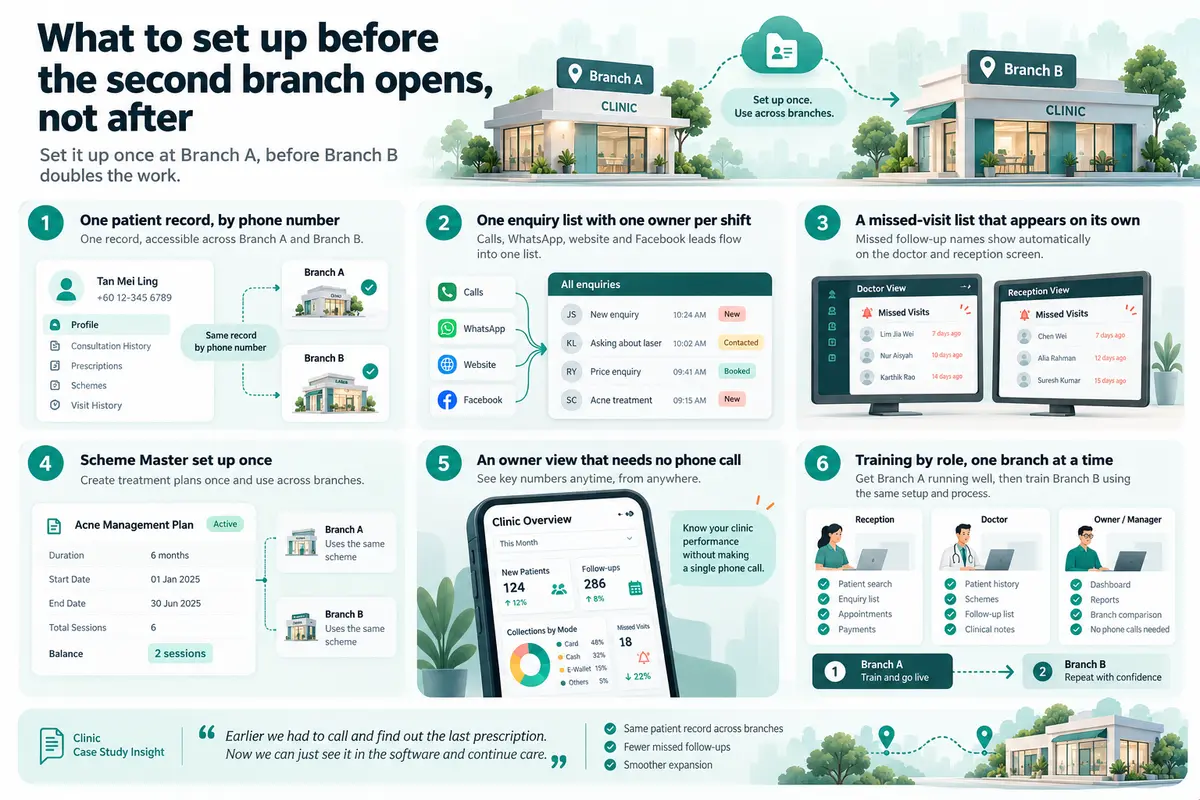
Most advice on how to start a homeopathy clinic, or a second one, covers the lease, the furniture and the doctor. The setup below is the part that gets left for "once we settle". Do it while there is still only Branch A, because everything you set up after opening day will be set up twice.
One patient record, by phone number. Decide that the file follows the patient, not the branch. If you keep paper, start a single numbering series across both branches today. If you move to a web dashboard and Android app, set it up so a Branch A file opens at Branch B with access set per role and per branch.
One enquiry list with one owner per shift. Facebook, website, WhatsApp and phone enquiries into one place. Write the same-day callback rule on the wall of both receptions.
A missed-visit list that appears on its own. Every evening, every branch, the names of patients due today who did not come, on the doctor's screen and on reception's. Then a rule for who calls and when.
Scheme Master set up once. Name, duration and amount for every scheme, so assigning one at either branch calculates the end date and shows the balance on each visit.
An owner view that needs no phone call. New and follow-up patients by branch and doctor, collections by mode, missed visits, on your phone by 9 am.
Training by role, one branch at a time. Reception first, then doctors, then the owner's reports. The Branch A team becomes the people who train Branch B.
This is the order a homeopathy clinic in Pune followed on RevisitPlus: it put one record in place while it ran one branch, then opened a second and, within a few months, a third. Their Chief Homoeopath put the problem plainly: "As we have three branches, patients can go from one branch to another, so earlier we had to call and find out what the last prescription was. Through the software, without calling anyone, we can just see it in the software and go ahead with the next prescription." The full story is in the case study.
Bottom line
A second branch doubles the leaks before it doubles the patients. The nine signs above all reduce to one question: does Branch A run on a system, or on the people who happen to be in the room? Tonight, ask your receptionist to write down what happens to a missed follow-up and to a Facebook enquiry. If both answers are steps with a name and a time, start looking at premises. If either answer is "I tell the doctor", fix that first, at one branch.
Frequently asked questions
When should a clinic open a second branch?
Open a second branch when the first one runs without the owner at the counter: enquiries have an owner, missed follow-ups are seen the same day, every patient has one record, day-end matches, and the owner can see the week without phoning. Demand is necessary but not enough. A full waiting room at Branch A does not tell you whether the system behind it can be copied.
How do you manage two clinic locations?
Run them as one clinic with two addresses. One patient record that either branch can open by phone number, one enquiry list, one missed-visit list per branch that appears every evening, and one owner view that shows both branches by doctor and payment mode. Access is set per role and per branch so each team sees its own patients while the owner sees everything.
What are the challenges of a multi-branch clinic?
Five, and they arrive together. Enquiries for two addresses with no single owner. Follow-ups missed at the branch the owner is not in. Patient records split between buildings, so a doctor needs a phone call before prescribing. Two day-ends and two drawers to count. And an owner view that becomes a morning phone round instead of a screen.
How do patients' records move between clinic branches?
With paper, they do not move. Someone phones the other branch and reads out the last prescription. With one record on a web dashboard and Android app, the file is not stored at a branch at all. Reception at Branch B finds the patient by phone number and the doctor sees the Branch A history, scheme and follow-up dates before the consult.
How much staff does a second clinic branch need?
At minimum one receptionist and one consulting doctor per shift, plus whoever dispenses. The bigger question is who trains them. A ready clinic has a Branch A receptionist who can write her day down as steps and spend the first fortnight at Branch B. If every question still goes to the owner, add a practice manager before you add the branch.
Should each clinic branch have its own software?
No. Separate systems per branch recreate the paper problem on screens: two patient lists, two sets of reports, and a phone call whenever a patient crosses over. One system with branch-level access gives each team its own view and gives the owner both branches on one screen.
How do I keep quality the same across clinic branches?
Write the reception day down as steps and train both branches on the same steps. Then watch the same numbers for each branch every week: Revisit Rate by doctor, missed visits called back, enquiries that became patients, and day-end variance by mode. When the numbers diverge, you know which branch to spend the morning at.